This section allows you to view all posts made by this member. Note that you can only see posts made in areas you currently have access to.
Messages - Jemand
1
« on: October 06, 2025, 01:47:40 PM »
The OP appears to have been frightened off by all of our questions. Perhaps he just wanted to lecture us and not have a back-and-forth discussion.
You occasionally get those who see the board as a pulpit to teach from, rather than a forum for meaningful dialogue.
And sometimes the very opposite is true. However, a meaningful conversation between a rude, unbelieving Jew and a conservative, evangelical Christian may not be possible.
A meaningful conversation between a narcissistic condescending arrogant jerk who knows it all and is steeped in academic pride and a conservative loving Jew may also not be possible
Do you believe that you are better than such an imaginary person? Have you contributed anything but insults to a discussion about Genesis 1-11? Is a thirst for knowledge and the truth characteristic of someone who thinks he knows it all? I am not the one who refuses to study the Tanakh and studies of it because he thinks he already knows all there is to know about it? I am not the one who belittles and insults Christian Biblical scholars whose beliefs are based upon objective facts rather than upon silly superstitions. I believe “that Christ died for our sins in accordance with the scriptures, 4. that he was buried, that he was raised on the third day in accordance with the scriptures, 5. and that he appeared to Cephas, then to the twelve. 6. Then he appeared to more than five hundred brethren at one time, most of whom are still alive, though some have fallen asleep. 7. Then he appeared to James, then to all the apostles.” (From 1 Cor. 15:3-7 in the RSV) Fenris denies all of these things! Let’s discuss the topic of this thread rather than each other.
2
« on: October 06, 2025, 02:18:42 AM »
The OP appears to have been frightened off by all of our questions. Perhaps he just wanted to lecture us and not have a back-and-forth discussion.
You occasionally get those who see the board as a pulpit to teach from, rather than a forum for meaningful dialogue.
And sometimes the very opposite is true. However, a meaningful conversation between a rude, unbelieving Jew and a conservative, evangelical Christian may not be possible.
3
« on: October 06, 2025, 01:08:23 AM »
The Crucifixion timeline forms a perfect cross on a modern clock when Jewish & Roman times are aligned. This alignment between the Crucifixion Timeline and the Time Clock is a strikingly precise match.
**The 3rd Hour (3) → 9:00 AM → Right Side of the Horizontal Beam**
According to Mark 15:25, Jesus was crucified at the 3rd hour.
When the Crucifixion timeline is aligned onto the 12-hour time clock, the 3rd hour (Jewish time) corresponds to 9:00 AM (Roman time).
This places 9:00 AM at the right end of the horizontal beam, aligning it perfectly.
**The 6th Hour (6) → 12:00 PM → Top of the Vertical Beam**
According to Matthew 27:45, Mark 15:33, and Luke 23:44, darkness fell over the land at the 6th hour (12:00 PM).
On the time clock, the 6th hour (Jewish) corresponds to 12:00 PM (Roman).
This directly aligns with the top of the vertical beam, reinforcing the divine connection between time and the cross.
**The 9th Hour (9) → 3:00 PM → Left Side of the Horizontal Beam**
According to Matthew 27:46, Jesus cried out and gave up His spirit at the 9th hour (3:00 PM).
On the time clock, the 9th hour (Jewish) corresponds to 3:00 PM (Roman).
This places 3:00 PM at the left end of the horizontal beam, again aligning perfectly.
**A look at the pictorial depiction of the convergence of The Roman and Jewish Timelines:**
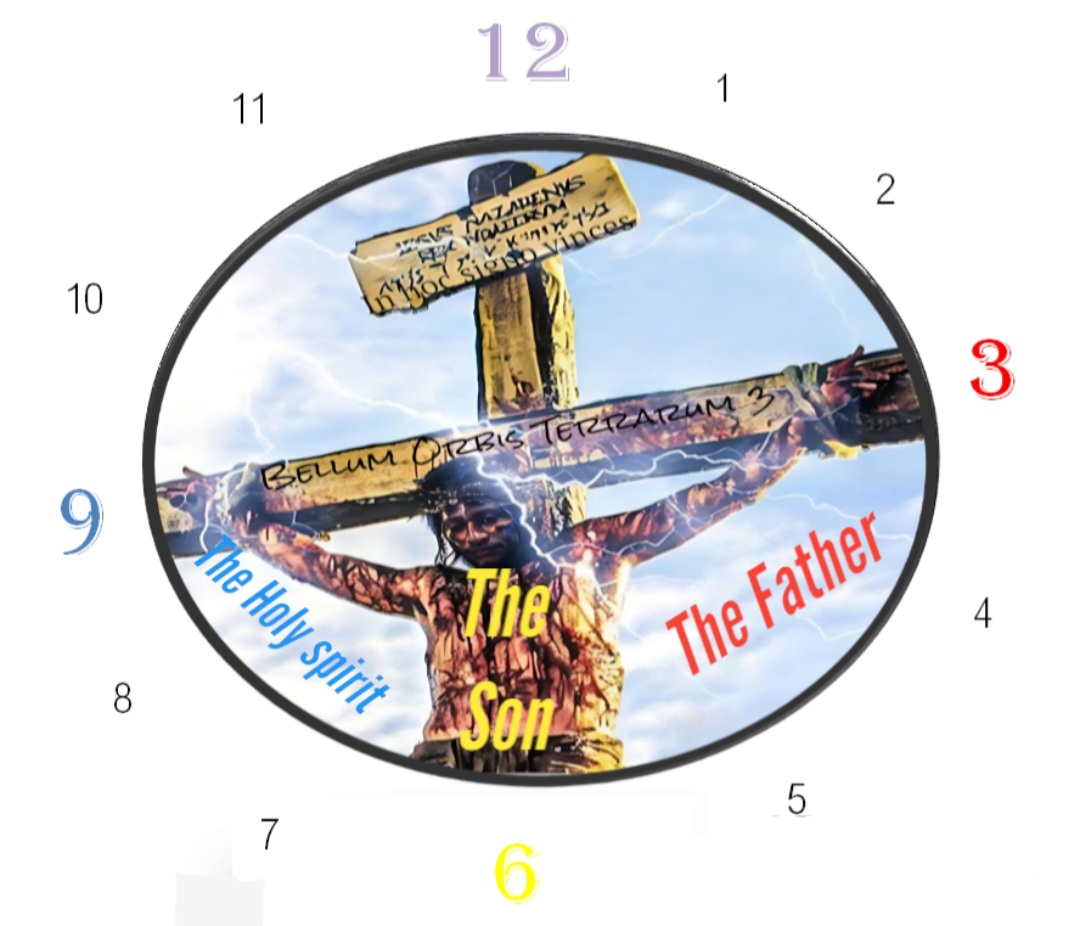
**The convergence of Crucifixion timelines form a perfect Cross: The ultimate symbol of Crucifixion, Resurrection, and Salvation**
The exact same thing has been posted on a multitude of “Christian” websites without giving the author credit for what he wrote.
4
« on: October 06, 2025, 12:39:07 AM »
And you can stop using the Septuagint or the Samaritan bible or the Latin or the Dead Sea scrolls as authoritative. In every instance, we A) don't know who wrote them; and B) With the exception of the DSS, they were not written by Jews. So I really don't care what they say.
The Septuagint is a translation of Tanakh and a collection of other writings. The Apostle Paul quoted from it more often than from the Masoretic Text. The Samaritan Hebrew text of the Old Testament is a translation of the first five books of Moses in the Tanakh. The Latin Vulgate is a translation of the Bible including the Tanakh. These translations were made before some disrespectful Gentiles mutilated the Masoretic Text. The Dead Sea Scrolls were written by Jews in Hebrew during the Second Temple period. For detailed information about The Dead Sea Scrolls, please see the 40-volume work, Discoveries in the Judaean Desert (DJD) published by Oxford University, 1955-2009. If it were not for these ancient documents, the Jews today would be stuck with a badly corrupted Jewish text and the Christians today would have very inaccurate Bibles. Most unfortunately, however, many observing Jews and fundamentalist Christians are so severely caught up in superstition and inexcusable willful ignorance that they are relying upon corrupted texts rather than the word of God.
5
« on: October 05, 2025, 01:11:12 AM »
While we're still on the topic, I will direct your attention to the poem that is Deuteronomy 32.
This chapter lays out all of Jewish history, from the beginning in the land of Israel until the end of days.
It starts with "Listen, you heavens, and I will speak; hear, you earth, the words of my mouth."
It speaks of the 40 years on the desert-
In a desert land he found him,
in a barren and howling waste.
He shielded him and cared for him;
he guarded him as the apple of his eye,
like an eagle that stirs up its nest
and hovers over its young,
that spreads its wings to catch them
and carries them aloft.
It mentions the downfall into immorality and idolatry-
Jeshurun grew fat and kicked;
filled with food, they became heavy and sleek.
They abandoned the God who made them
and rejected the Rock their Savior.
They made him jealous with their foreign gods
and angered him with their detestable idols.
and then
The Lord saw this and rejected them
because he was angered by his sons and daughters.
God considers the punishment, but holds back from complete destruction-
I will heap calamities on them
and spend my arrows against them.
I will send wasting famine against them,
consuming pestilence and deadly plague;
I will send against them the fangs of wild beasts,
the venom of vipers that glide in the dust.
In the street the sword will make them childless;
in their homes terror will reign.
The young men and young women will perish,
the infants and those with gray hair.
I said I would scatter them
and erase their name from human memory,
but I dreaded the taunt of the enemy,
lest the adversary misunderstand
and say, ‘Our hand has triumphed;
the Lord has not done all this.’”
And how does the story end?
Rejoice, you nations, with his people,
for He will avenge the blood of His servants;
He will take vengeance on His enemies
and make atonement for His land and people.
You will note that the last statement, as in chapter 30, is not conditional. God will avenge the spilled blood of His servants. God will make atonement for His land and His people.
We already know how the story ends. All we choose is what role to play.
Three points: 1. Ancient Hebrew poetry expresses subjective feelings and emotions rather than objective facts past, present, or future. 2. Deuteronomy 32 in the Masoretic text has become badly damaged. In v. 43, the Hebrew word for “heavens” has been changed to the Hebrew word for “nations.” The line, “worship him, all you gods!” is missing. However, it is present in the Qumran manuscripts and the Septuagint. The Hebrew word for “children” has been changed to the Hebrew word for “servants’. The line, “he will repay those who hate him,” is missing. However, it is present in the Qumran manuscripts and the Septuagint. In v. 44, the name Hoshea appears rather than the correct name Joshua as in the Samaritan Pentateuch, the Septuagint, the Syriac version of the Old Testament, and the Latin Vulgate. 3. Compare Jonah 3:10. When God saw what they did, how they turned from their evil ways, God changed his mind about the calamity that he had said he would bring upon them; and he did not do it.
6
« on: October 01, 2025, 03:01:17 AM »
We both know It's not clear to me at all what "we both know".
that that the Masoretic text is not just missing a word in Deut. 30:16, it is missing an entire clause, “If you obey the commandments of the Lord your God”. I am not the one who is playing games with the word of God and willfully and deliberately misrepresenting the truth. I mean, yeah, you are. You're claiming that words are missing from the canonical bible.
Furthermore, there are very numerous places in the Masoretic where it is missing entire phrases, clauses, and sentences that are found in older manuscripts of the Tanakh. You will helpfully provide examples?
Many centuries ago, the Hebrew people began to esteem some writing more highly than others. The writings that they especially esteemed they began to circulate by making copies of them and passing them around. These Hebrew people, like all people, were fallible and made coping errors. These errant copies were in turn copied and the people who copied them copied the errors and added errors of their own. Beginning late in the 5th century and continuing on through the 10th century groups of Hebrew scholars and scribes known at the Masoretes began producing copies of the manuscripts that included diacritical marks in an effort to standardize the pronunciation of the words and added paragraph and verse divisions. And yet bibles from Israel to Europe to Africa and even forgotten parts of the Jewish world like Yemen all have the same bible. This, at a time when there was no central unifying authority. It's almost as if they all had the same bible from time immemorial...
However, the Dead Sea Scrolls dating from about 150 BC – 75 AD, reveal that during this period there was no standardized text of the ancient Hebrew documents that eventually became our Old Testament.
Of course there was a standardized version. It's the one I just told you about, above. The canonical version. We don't know who wrote the dead sea scrolls, and they're not canonical.
Moreover, the Septuagint, a Greek Translation of the Hebrew documents made during the third and second centuries BC, was made from texts very different from the later Masoretic Text. By 70 AD, multiple versions of the Hebrew Scriptures existed. Moreover, the Peshitta (a Syriac translation made in the second century AD), the Samaritan Pentateuch (a Samaritan translation of the Pentateuch made in about 120 AD., and the Latin Vulgate (a Latin translation of the Bible made primarily by Jerome in the last part of the 4th century AD) all differ significantly from the Masoretic Text but partially agree with each other. The RSV and the NRSV take into consideration all of these texts in an effort to provide us with a translation as close as possible to the original Hebrew writings. For example, Genesis 4:8, in the KJV, reads,
8. And Cain talked with Abel his brother: and it came to pass, when they were in the field, that Cain rose up against Abel his brother, and slew him.
In the RSV, it reads,
8. Cain said to Abel his brother, “Let us go out to the field.” And when they were in the field, Cain rose up against his brother Abel, and killed him.
In the NRSV, it reads,
8. Cain said to his brother Abel, “Let us go out to the field.” And when they were in the field, Cain rose up against his brother Abel, and killed him. Well I just looked at the Hebrew, and the KJV is right.
The RSV and the NRSV include a textual note that accurately reads, “Sam Gk Syr Compare Vg: MT lacks [Let us go out to the field].” That is, the Samaritan Pentateuch, the Septuagint, and the Syriac Peshitta include the quote, the Latin Vulgate rewords the quote to “suum egrediamur foras” (let us go outside). The Masoretic Text, however lacks the quote. Because the genuineness of the quote is so well supported, it is included in the RSV and the NRSV. It's amazing that in your opinion everyone has the right copy of the Jewish bible- except the Jews. Lol.
Although I am a Christian rather than a Jew, I highly value the Tanakh and find enjoyment in reading it and studying it—and in reading what other students of the Tanakh have gleaned from reading and studying it. Most unfortunately, not all Jews and Christians share my appreciation for the Scripture that God has so graciously blessed us with.
I'm not sure that I would call it "appreciation". You hunt around for a translation of the bible that fits your preconceived notions on what it should say, and adopt that as your own personal canon. When you should just be reading the bible that is.
It is true that that very many Jews have set up the Masoretic text as an idol to be worshipped. However, the term “canonical Bible” refers to a collection of writings that a religious community believes to be canonical. In Judaism, we have several religious communities that differ in their opinion regarding which books belong in the Jewish Canon. The religious community known as “Rabbinic Judaism” considers 24 books to be canonical. These are the 24 books found in the Masoretic text. The Greek-speaking Jews of Alexandria considered additional books to be canonical and included them in their translation of the Hebrew Bible. When Jesus went to the synagogue on the Sabbath day and stood up to read, the scroll of the prophet Isaiah was handed to him and he read from it aloud in the synagogue, Luke 4:16. When he came to Nazareth, where he had been brought up, he went to the synagogue on the sabbath day, as was his custom. He stood up to read, 17. and the scroll of the prophet Isaiah was given to him. He unrolled the scroll and found the place where it was written: 18. “The Spirit of the Lord is upon me, because he has anointed me to bring good news to the poor. He has sent me to proclaim release to the captives and recovery of sight to the blind, to let the oppressed go free, 19. to proclaim the year of the Lord's favor.” 20. And he rolled up the scroll, gave it back to the attendant, and sat down. The eyes of all in the synagogue were fixed on him. 21. Then he began to say to them, “Today this scripture has been fulfilled in your hearing.” This quote is not from the Masoretic text, it is from the Septuagint. When we compare the Bibles used by various Christian groups, we find the following writings that are not found in the Protestant Canon but which are found in the Bibles of other Christian groups: Books and Additions to Esther and Daniel that are in the Roman Catholic, Greek, and Slavonic BiblesTobit Judith The Additions to the Book of Esther found in the Greek Version The Wisdom of Solomon Ecclesiasticus, or the Wisdom of Jesus, Son of Sirach Baruch The Letter of Jeremiah (Baruch ch. 6) The Additions to the Greek Book of Daniel The Prayer of Azariah and the Song of the Three Jews Susanna Bel and the Dragon 1 Maccabees 2 Maccabees Books in the Greek and Slavonic Bibles; Not in the Roman Catholic Canon1 Esdras (2 Esdras in the Slavonic Bible, 3 Esdras in Appendix to the Vulgate) The Prayer of Manasseh Psalm 151 3 Maccabees A composite book in the Slavonic Bible and in the Latin Vulgate Appendix2 Esdras (3 Esdras in the Slavonic Bible, 4 Esdras in the Vulgate Appendix; “Esdras” is the Greek form of “Era”) (Note: In the Latin Vulgate, Ezra- Nehemiah are 1 and 2 Esdras.) A book in an Appendix to the Greek Bible4 Maccabees (This book is included in two important Bibles from the fourth and fifth centuries.)
7
« on: September 30, 2025, 09:23:51 PM »
I have constructed a sentence in Hebrew for your perusal. The sentence is "הכלב גדול", which translated into English means "the dog is big". (Shakespeare, look out!)
If we break the sentence apart into the two words that comprise it, we have הכלב "the dog" and "גדול" big. Reading it in English, what it says is "The dog big". Hmm. There seems to be a missing word. Was it lost centuries ago? Does the Septuagint have the correct translation? Or is Hebrew a compact language where words are added by the fluent reader?
For that matter, the Hebrew language when written also lacks vowels, which is, again, not a problem for the fluent reader.
We both know that the Masoretic text is not just missing a word in Deut. 30:16, it is missing an entire clause, “If you obey the commandments of the Lord your God”. I am not the one who is playing games with the word of God and willfully and deliberately misrepresenting the truth. Furthermore, there are very numerous places in the Masoretic where it is missing entire phrases, clauses, and sentences that are found in older manuscripts of the Tanakh. Many centuries ago, the Hebrew people began to esteem some writing more highly than others. The writings that they especially esteemed they began to circulate by making copies of them and passing them around. These Hebrew people, like all people, were fallible and made coping errors. These errant copies were in turn copied and the people who copied them copied the errors and added errors of their own. Beginning late in the 5th century and continuing on through the 10th century groups of Hebrew scholars and scribes known at the Masoretes began producing copies of the manuscripts that included diacritical marks in an effort to standardize the pronunciation of the words and added paragraph and verse divisions. However, the Dead Sea Scrolls dating from about 150 BC – 75 AD, reveal that during this period there was no standardized text of the ancient Hebrew documents that eventually became our Old Testament. Moreover, the Septuagint, a Greek Translation of the Hebrew documents made during the third and second centuries BC, was made from texts very different from the later Masoretic Text. By 70 AD, multiple versions of the Hebrew Scriptures existed. Moreover, the Peshitta (a Syriac translation made in the second century AD), the Samaritan Pentateuch (a Samaritan translation of the Pentateuch made in about 120 AD., and the Latin Vulgate (a Latin translation of the Bible made primarily by Jerome in the last part of the 4th century AD) all differ significantly from the Masoretic Text but partially agree with each other. The RSV and the NRSV take into consideration all of these texts in an effort to provide us with a translation as close as possible to the original Hebrew writings. For example, Genesis 4:8, in the KJV, reads, 8. And Cain talked with Abel his brother: and it came to pass, when they were in the field, that Cain rose up against Abel his brother, and slew him. In the RSV, it reads, 8. Cain said to Abel his brother, “Let us go out to the field.” And when they were in the field, Cain rose up against his brother Abel, and killed him. In the NRSV, it reads, 8. Cain said to his brother Abel, “Let us go out to the field.” And when they were in the field, Cain rose up against his brother Abel, and killed him. The RSV and the NRSV include a textual note that accurately reads, “Sam Gk Syr Compare Vg: MT lacks [Let us go out to the field].” That is, the Samaritan Pentateuch, the Septuagint, and the Syriac Peshitta include the quote, the Latin Vulgate rewords the quote to “suum egrediamur foras” (let us go outside). The Masoretic Text, however lacks the quote. Because the genuineness of the quote is so well supported, it is included in the RSV and the NRSV. Although I am a Christian rather than a Jew, I highly value the Tanakh and find enjoyment in reading it and studying it—and in reading what other students of the Tanakh have gleaned from reading and studying it. Most unfortunately, not all Jews and Christians share my appreciation for the Scripture that God has so graciously blessed us with.
8
« on: September 27, 2025, 02:35:48 AM »
A reiteration of the conditional promise (based on obedience) of the land to the COI
I would say not conditional, based on context.
The magnificent chapter 30 of Deuteronomy:
When all these blessings and curses I have set before you come on you and you take them to heart wherever the Lord your God disperses you among the nations, and when you and your children return to the Lord your God and obey him with all your heart and with all your soul according to everything I command you today, then the Lord your God will restore your fortunes and have compassion on you and gather you again from all the nations where he scattered you. Even if you have been banished to the most distant land under the heavens, from there the Lord your God will gather you and bring you back. He will bring you to the land that belonged to your ancestors, and you will take possession of it. He will make you more prosperous and numerous than your ancestors. The Lord your God will circumcise your hearts and the hearts of your descendants, so that you may love him with all your heart and with all your soul, and live. The Lord your God will put all these curses on your enemies who hate and persecute you. You will again obey the Lord and follow all his commands I am giving you today. Then the Lord your God will make you most prosperous in all the work of your hands and in the fruit of your womb, the young of your livestock and the crops of your land. The Lord will again delight in you and make you prosperous, just as he delighted in your ancestors, if you obey the Lord your God and keep his commands and decrees that are written in this Book of the Law and turn to the Lord your God with all your heart and with all your soul.
Now what I am commanding you today is not too difficult for you or beyond your reach. It is not up in heaven, so that you have to ask, “Who will ascend into heaven to get it and proclaim it to us so we may obey it?” Nor is it beyond the sea, so that you have to ask, “Who will cross the sea to get it and proclaim it to us so we may obey it?” No, the word is very near you; it is in your mouth and in your heart so you may obey it.
See, I set before you today life and prosperity, death and destruction. For I command you today to love the Lord your God, to walk in obedience to him, and to keep his commands, decrees and laws; then you will live and increase, and the Lord your God will bless you in the land you are entering to possess.
But if your heart turns away and you are not obedient, and if you are drawn away to bow down to other gods and worship them, I declare to you this day that you will certainly be destroyed. You will not live long in the land you are crossing the Jordan to enter and possess.
This day I call the heavens and the earth as witnesses against you that I have set before you life and death, blessings and curses. Now choose life, so that you and your children may live and that you may love the Lord your God, listen to his voice, and hold fast to him. For the Lord is your life, and he will give you many years in the land he swore to give to your fathers, Abraham, Isaac and Jacob.
The chapter doesn't begin with an "if", but a "when". I used the NIV because it's a good, readable translation. In the Hebrew, the chapter begins with "וְהָיָה֩" "And it will be". The next verse starts "and you will return to the Lord, your God, with all your heart and with all your soul". It's not a conditional contract; it's a prophecy of the distant future (which I believe we are experiencing now!)
Yes, I understand this.
It is not and IF statement... it is a WHEN statement.
And it is about relationship and obedience.
The translation I use starts with IF
This is NOT a translation issue; it is a textual issue. Deu 30:16 אשׁר אנכי מצוך היום לאהבה את־יהוה אלהיך ללכת בדרכיו ולשׁמר מצותיו וחקתיו ומשׁפטיו וחיית ורבית וברכך יהוה אלהיך בארץ אשׁר־אתה בא־שׁמה לרשׁתה׃ Deu 30:17 ואם־יפנה לבבך ולא תשׁמע ונדחת והשׁתחוית לאלהים אחרים ועבדתם׃ Deu 30:18 הגדתי לכם היום כי אבד תאבדון לא־תאריכן ימים על־האדמה אשׁר אתה עבר את־הירדן לבוא שׁמה לרשׁתה׃ Deu 30:19 העדתי בכם היום את־השׁמים ואת־הארץ החיים והמות נתתי לפניך הברכה והקללה ובחרת בחיים למען תחיה אתה וזרעך׃ Deu 30:20 לאהבה את־יהוה אלהיך לשׁמע בקלו ולדבקה־בו כי הוא חייך וארך ימיך לשׁבת על־האדמה אשׁר נשׁבע יהוה לאבתיך לאברהם ליצחק וליעקב לתת להם׃ Deut. 30:16. that I am commanding you today, by loving the Lord your God, walking in his ways, and observing his commandments, decrees, and ordinances, then you shall live and become numerous, and the Lord your God will bless you in the land that you are entering to possess. 17. But if your heart turns away and you do not hear, but are led astray to bow down to other gods and serve them, 18. I declare to you today that you shall perish; you shall not live long in the land that you are crossing the Jordan to enter and possess. 19. I call heaven and earth to witness against you today that I have set before you life and death, blessings and curses. Choose life so that you and your descendants may live, 20. loving the Lord your God, obeying him, and holding fast to him; for that means life to you and length of days, so that you may live in the land that the Lord swore to give to your ancestors, to Abraham, to Isaac, and to Jacob. (NRSV) In both the Hebrew text and the English translation of it, verse 16 is only a fragment of a sentence. The first part of the Hebrew sentence was lost over a millennium ago. Fortunately, before it was lost, a translation of it was made in Greek as part of the Septuagint giving us, ἐὰν εἰσακούσῃς τὰς ἐντολὰς κυρίου τοῦ θεοῦ σου: (If you obey the commandments of the Lord your God). Therefore, Deuteronomy 30:16 If you obey the commandments of the Lord your God that I am commanding you today, by loving the Lord your God, walking in his ways, and observing his commandments, decrees, and ordinances, then you shall live and become numerous, and the Lord your God will bless you in the land that you are entering to possess. (NRSV) Deuteronomy 30:16 If you obey the commandments of the Lord your God which I command you this day, by loving the Lord your God, by walking in his ways, and by keeping his commandments and his statutes and his ordinances, then you shall live and multiply, and the Lord your God will bless you in the land which you are entering to take possession of it. (RSV) Deuteronomy 30:16 If you obey the commandments of the LORD, your God, which I enjoin on you today, loving him, and walking in his ways, and keeping his commandments, statutes and decrees, you will live and grow numerous, and the LORD, your God, will bless you in the land you are entering to occupy. (NAB) But, Deuteronomy 30:16 In that I command thee this day to love the Lord thy God, to walk in his ways, and to keep his commandments and his statutes and his judgments, that thou mayest live and multiply: and the Lord thy God shall bless thee in the land whither thou goest to possess it. (KJV) The KJV inserts here the preposition “In” in order for the verse to make sense in its context. However, there is no such preposition the Hebrew text and the predecessor to the KJV, the Bishops Bible, includes no such insertion.
9
« on: September 19, 2025, 03:07:07 AM »
I only have one question….
Did anyone do anything that remotely told people about Jesus today…
Other than that, I do t care much any more
Too many in house family pissing matches and not enough external proclamation of the gospel
I appreciate your concern and I whole-heartedly support it. However, I do not believe that teddyv is off track here. Having a firm foundation upon which to base our faith is essential to the effective sharing or our faith. That firm foundation is often the result of soul-searching dialogs and debates that take us deeper and deeper into the word of God—including the languages in which God chose to give it to us. However, Kurt Wise and Todd Wood are not the problem at Answers in Genesis—the problem is Ken Ham!
10
« on: September 12, 2025, 02:29:21 AM »
Dragons….
Pfffffffff
I do not understand your posts.
11
« on: September 12, 2025, 02:17:53 AM »
Paul H. Seely, in an article in The Westminster Theological Journal 53 (1991) 227-40, correctly writes,
STANDARD Hebrew lexica and a number of modern biblical scholars
have defined the raqiac (fyqr, "firmament") of Gen 1:6-8 as a solid dome
over the earth.
Modern biblical scholars. Great. That doesn't mean that they're right, or that this is how the words were understood in ancient times. As I have already said, there are no mainstream Jewish or Christian sects that understand the word that way. It doesn't matter how many "modern scholars" you quote.
Dismissing out of hand as wrong the views of scholars representing a very wide spectrum of theological thought (Jewish, Islamic, Roman Catholic, Eastern Orthodox, Protestant, etc.) simply because their views are different than yours (whatever that view may be—you have not told us) does not mean that you are right and that they are wrong. Indeed, all that we have gotten from your posts is that they are wrong with no Hebrew lexica, commentaries on the Hebrew text, peer reviewed journal articles, etc., to support the claim that they are wrong. I, on the other hand, have provided direct quotes from all of the above. The article that I referenced above by Paul Seely is a detailed peer reviewed journal article that supports the view that the Hebrew word רָקִיעַ is correctly translated as “dome” in the context of Genesis 1:6-8. Do you have any evidence that the view that he supports is wrong?
12
« on: September 11, 2025, 02:37:57 PM »
I'm not sure what Fenris might say, but I see these stories as setting the history of the fledgling Israelite nation. Assuming the typical YEC history of 6000 years, the first 11 chapters cover about a third of all human history.
There is so much common imagery with other ANE stories, but radically different, particularly with respect to the monotheism and the placement of humanity within the created order, which stands against many other contrmporary myths.
There are certain things like Noah being instructed about taking clean and unclean animals well before these were defined for the Israelites that suggest at least a later collation and editing of probable oral history.
I like what you wrote but I disagree with the YEC history of 6000 years.
I am most certainly not a YEC adherent.
Excellent! I now much more accurately understand your post. Thank you!
13
« on: September 11, 2025, 02:28:20 PM »
Yes, Genesis 4:23 is an example of poetry in Genesis 1-11. Wow! So you mean that there are parts of the bible actually are poetic?
The meaning of "יוֹם" is determined from the context. No, the word simply means "day".
The Hebrew Masoretic text of Genesis 1:6-8 expressly describes the creation of a flat earth covered with a dome that “separated the waters that were under the dome from the waters that were above the dome.”
1:6 ויאמר אלהים יהי רקיע בתוך המים ויהי מבדיל בין מים למים׃
1:7 ויעשׂ אלהים את־הרקיע ויבדל בין המים אשׁר מתחת לרקיע ובין המים אשׁר מעל לרקיע ויהי־כן׃
1:8 ויקרא אלהים לרקיע שׁמים ויהי־ערב ויהי־בקר יום שׁני׃
I can read the Hebrew just fine, and it says nothing about a "flat earth covered with a dome".
The Septuagint also expressly describes the creation of a flat earth covered with a dome that “separated the waters that were under the dome from the waters that were above the dome.” I don't know who translated the Septuagint and don't consider its translation to be correct or binding.
The Latin Vulgate also expressly describes the creation of a flat earth covered with a dome that “separated the waters that were under the dome from the waters that were above the dome.” I don't consider the Latin to be authoritative or binding either.
The NRSV correctly translates the Hebrew word רָקִיעַ as “dome.” You consider it "correct" because it supports your contention, not because it's the actual, correct translation.
The evidence for the correctness of this translation is found in the use of this word in ancient Hebrew literature. Based upon this usage, the Hebrew and English Lexicon of the Old Testament by Brown, Driver, and Briggs published by Oxford University gives us the following meaning of it in Gen. 1:6, 7, and 8, “the vault of heaven, or ‘firmament,’ regarded by Hebrews as solid, and supporting ‘waters’ above it.” (p. 956) I don't care what Oxford university says, either.
The KJV correctly translates the Hebrew word רָקִיעַ (râqı̂ya‛) as “firmament”, but most modern readers of the KJV are unaware of the meaning of the word “firmament,” and do not realize that it came down to us from the Latin present active infinitive (firmāre) of the Latin verb firmō, meaning “I make firm, strengthen, harden, or fortify” and that it expresses the concept of the strong, solid dome that supported the water above the dome. None of which has any bearing on what the Hebrew word actually means.
In the Cyclopedia of Biblical, Theological, and Ecclesiastical Literature, we find an excellent article (Vol. III, pp. 568-569 [two lengthy columns of fine print per page] on the word רָקִיעַ. Of special importance is the following from the article,
The verb רָקַע, raká, means to expand by beating, whether by the hand, the foot, or any instrument. It is especially used, however, of beating out metals into thin plates (Exod. xxxix, 3, Numb. xvi, 39), and hence the substantive רַקֻּעַים “broad plates” of metal (Numb. 16:38). (The italics are theirs).
John Skinner, the late Principal and Professor of Old Testament Language and Literature at Westminster College, Cambridge, in his commentary on the Hebrew text of Genesis, writes,
6-8 Second Work: The Firmament.—The second fiat calls into existence a firmament, whose function is to divide the primeval waters into an upper and lower ocean, leaving a space between as the theater of further creative developments. The “firmament” is the dome of heaven, which to the ancients was no optical illusion, but a material structure, sometimes compared to an “upper chamber” (Ps. 104:12, Am 9:6) supported by “pillars” (Jb 26:11), and resembling in its surface a “molten mirror” (Jb 37:18). Above this are the heavenly waters, from which the rain descends through “windows” or “doors” (Gn 7:11, 8:2, 2 Ki 7:2, 19) opened and shut by God at His pleasure (Ps 78:23).
All you're doing is cherry picking from the vast volume of literature that's been written on the bible and finding commentators who say what you want.
I'll again direct your attention to verse 8: "And God called the firmament Heaven" וַיִּקְרָ֧א אֱלֹהִ֛ים לָֽרָקִ֖יעַ שָׁמָ֑יִם which by your interpretation means that heaven is a physical dome.
Paul H. Seely, in an article in The Westminster Theological Journal 53 (1991) 227-40, correctly writes, STANDARD Hebrew lexica and a number of modern biblical scholars
have defined the raqiac (fyqr, "firmament") of Gen 1:6-8 as a solid dome
over the earth.1 Conservative scholars from Calvin on down to the present,
however, have defined it as an atmospheric expanse.2 Some conservatives
have taken special pains to reject the concept of a solid dome on the basis
that the Bible also refers to the heavens as a tent or curtain and that refer-
ences to windows and pillars of heaven are obviously poetic.3 The word
raqiac, they say, simply means "expanse." They say the understanding of
raqiac as a solid firmament rests on the Vulgate's translation, firmamentum;
and that translation rests in turn on the LXX's translation stere<wma,
which simply reflected the Greek view of the heavens at the time the trans-
lators did their work.4 The raqiac defined as an atmospheric expanse is the
historical view according to modern conservatives; and the modern view of
the raqiac as a solid dome is simply the result of forcing biblical poetic
language into agreement with a concept found in the Babylonian epic
Enuma Elish.5
The historical evidence, however, which we will set forth in concrete
detail, shows that the raqiac was originally conceived of as being solid and
not a merely atmospheric expanse. The grammatical evidence from the
OT, which we shall examine later, reflects and confirms this conception of
solidity. The basic historical fact that defines the meaning of raqiac in Gene-
sis 1 is simply this: all peoples in the ancient world thought of the sky as
solid. This concept did not begin with the Greeks.
The question, however, arises in the modern mind, schooled as it is in the
almost infinite nature of sky and space: Did scientifically naive peoples
really believe in a solid sky, or were they just employing a mythological or
poetic concept? Or were they, perhaps, just using phenomenal language
with no attending belief that the sky actually was a solid object? That is,
were they referring to the mere appearance of the sky as a solid dome but
able to distinguish between that appearance and the reality?
The answer to these questions, as we shall see more clearly below, is that
scientifically naive peoples employed their concept of a solid sky in their
mythology, but that they nevertheless thought of the solid sky as an integral
part of their physical universe. And it is precisely because ancient peoples
were scientifically naive that they did not distinguish between the appear-
ance of the sky and their scientific concept of the sky. They had no reason
to doubt what their eyes told them was true, namely, that the stars above
them were fixed in a solid dome and that the sky literally touched the earth
at the horizon. So, they equated appearance with reality and concluded
that the sky must be a solid physical part of the universe just as much as
the earth itself.
14
« on: September 11, 2025, 02:08:20 PM »
I'm not sure what Fenris might say, but I see these stories as setting the history of the fledgling Israelite nation. Assuming the typical YEC history of 6000 years, the first 11 chapters cover about a third of all human history.
There is so much common imagery with other ANE stories, but radically different, particularly with respect to the monotheism and the placement of humanity within the created order, which stands against many other contrmporary myths.
There are certain things like Noah being instructed about taking clean and unclean animals well before these were defined for the Israelites that suggest at least a later collation and editing of probable oral history.
I like what you wrote but I disagree with the YEC history of 6000 years.
I am most certainly not a YEC adherent.
This poster is merely playing copy pasta. Their reply above to Fenris is lifted from https://creation.com/jesus-right-on-genesis, as well as a couple of other forums. I'm debating closing this thread as the user is effectively stealing other people's content by failing to attribute.
The work is my own! I wrote a letter to Shaun Doyle at Creation Ministries International and, without my permission, he published it verbatim it in an article. I have posted similar work on Christian Forums and the Baptist Board. As you can see for yourself, when I quoted from John Skinner and others scholars, I always gave them credit for their work.
15
« on: September 11, 2025, 03:25:52 AM »
(and the rest of the Hextateuch)
Whoops, I just noticed this. This is a modern term, only coming into use after 1870 or so. I'm not aware of any Jewish or Christian sects who believe that the book of Joshua is part of the five books of Moses.
The book of Joshua is part of the Hextateuch—the first six books of the Tanakh.
|
Watcha doing?
by Athanasius
Today at 03:34:11 AM
|
Genesis 1:1
by IMINXTC
October 07, 2026, 06:06:18 PM
|
Put me on your prayer list
by Cloudwalker
October 04, 2026, 06:35:39 PM
|
Earthquake statistics
by IMINXTC
October 04, 2026, 12:40:38 AM
|
The fallen tent of David.
by Fenris
September 23, 2026, 04:26:01 PM
|
How far back does the Protestant split with Catholicism go?
by Fenris
September 22, 2026, 12:34:26 PM
|
Is Teaching People How to Evangelize Heresy?
by RabbiKnife
September 10, 2026, 08:03:33 AM
|
Its clear in the Bible, you do not go to Heaven or to Hell, when you die.
by Fenris
August 26, 2026, 12:26:37 PM
|
Silly
by RabbiKnife
August 26, 2026, 10:48:10 AM
|
Does God manifest His love in the animal world too?
by Athanasius
August 17, 2026, 12:33:28 PM
|
Have people rightly understood the primary doctrine on Father, Son & Holy Ghost?
by RabbiKnife
August 17, 2026, 06:14:15 AM
|
Understanding what Christ is doing in Heaven at this time.
by IMINXTC
August 14, 2026, 12:03:07 PM
|
Do you know then God of Jesus?
by Athanasius
August 14, 2026, 06:02:07 AM
|
Glorified body
by RabbiKnife
August 14, 2026, 05:22:11 AM
|
The Jews will be kept safe in the Great Tribulation
by Fenris
August 12, 2026, 01:42:00 PM
|
What is Faith?
by Fenris
August 09, 2026, 12:49:58 PM
|
Doctrine of Original Sin
by Fenris
August 06, 2026, 06:42:45 PM
|
Do You Know How to be Saved?
by Fenris
August 06, 2026, 05:56:09 PM
|
Looking at Col. 2:16
by Richard Aberdeen
August 06, 2026, 05:19:32 PM
|
Can the law grant eternal life?
by Richard Aberdeen
August 06, 2026, 05:14:31 PM
|
|
|




 Show Posts
